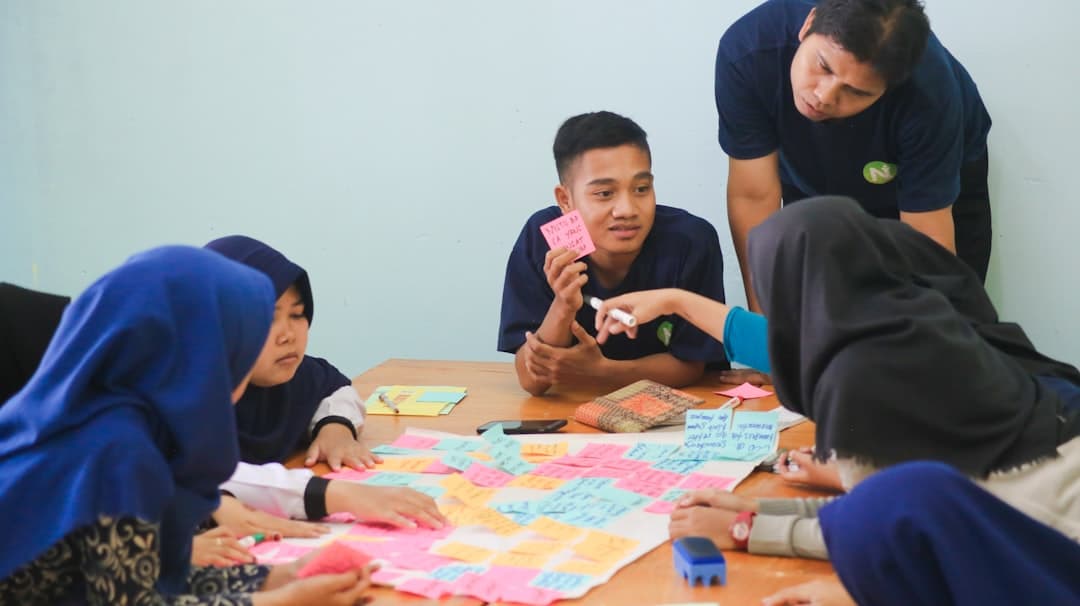
Differentiated instruction with AI means using AI tools to quickly produce multiple versions of the same lesson content, adjusted for different reading levels, language proficiencies, or learning needs, without rewriting each version by hand. It turns a task that used to take hours into one that takes minutes, giving every student material pitched at their actual level.
In practice, differentiated instruction with AI means feeding one core text, activity, or assessment into a tool and asking it to produce several versions calibrated to different levels, then reviewing each version before using it with real students. A teacher working with a mixed-level class might take a single reading passage about renewable energy and generate three versions: a simplified version with shorter sentences and higher-frequency vocabulary for beginners, the original for the middle group, and an extended version with more complex structures and additional discussion questions for advanced students. All three versions cover the same topic and vocabulary theme, so the class can still discuss the reading together, but no student is stuck with material either too easy or too far out of reach.
The same logic applies to comprehension questions, writing prompts, and even instructions for group tasks. Rather than writing three separate worksheets from scratch, or worse, giving the whole class one worksheet that suits only the middle of the group, a teacher can adapt in minutes what used to take an entire planning period. That time savings is the entire practical case for using AI here: differentiation has always been recognized as good practice, the barrier was never the idea, it was the time it took to execute properly across a full class.
Differentiated instruction has always been hard to do consistently because doing it properly by hand requires a teacher to essentially write multiple lessons for every single class they teach. Carol Ann Tomlinson’s foundational work on differentiated instruction, widely used in teacher training, describes differentiation as adjusting content, process, and product based on student readiness, interest, and learning profile, a genuinely comprehensive framework that is straightforward to describe in theory and exhausting to execute for every lesson in practice (ASCD).
Most teachers who have tried to differentiate thoroughly by hand hit the same wall: with twenty five or thirty students across a range of levels, writing genuinely tailored materials for even three sub-groups multiple times a week is not sustainable alongside grading, meetings, and everything else on a teacher’s plate. The result, historically, has often been differentiation in name only: the same worksheet for everyone, perhaps with a verbal note to “extend the strong students” that rarely translates into an actual written task. AI changes the math on this specific bottleneck, because generating a leveled variant of existing content is precisely the kind of transformation task language models handle quickly.
Learning design frameworks argue that multiple levels should be built into materials from the start rather than bolted on afterward as an afterthought. The CAST Universal Design for Learning guidelines, a framework widely referenced in education research and policy, call for offering multiple means of representation, action and expression, and engagement, so that variability among learners is planned for rather than treated as an exception to be accommodated case by case (CAST). That framing matters because it reframes differentiation from “extra work for struggling students” to “the normal way materials should be built for any group of real learners.”
AI tools fit naturally into that framing because they make “multiple means of representation” achievable without needing to hand-author every version. A reading passage rendered at three levels, or a set of instructions offered as both text and a simplified visual outline, becomes a five-minute task instead of a three-version writing project. The framework existed well before generative AI; AI simply removed the main practical obstacle to implementing it consistently.
| Differentiation task | Manual approach | AI-assisted approach | Time typically saved |
|---|---|---|---|
| Leveled reading passages | Teacher rewrites text 2-3 times by hand | AI generates leveled versions from one source text | Substantial, often most of a planning period |
| Tiered comprehension questions | Teacher drafts separate question sets per level | AI produces question sets matched to each text version | Moderate to substantial |
| Scaffolded writing prompts | Teacher writes sentence starters and word banks manually | AI generates scaffolds tailored to specified proficiency | Moderate |
| Vocabulary glossaries per level | Teacher selects and defines terms by hand | AI extracts and defines level-appropriate vocabulary | Substantial |
Source note: task categories reflect common ESL differentiation practice described in Carol Ann Tomlinson’s differentiated instruction framework (ASCD) and the CAST Universal Design for Learning guidelines, both cited above; actual time savings vary by class size, subject matter, and tool used.

Start with the source material you already have: a reading text, a set of instructions, or a writing task, rather than generating everything from a blank prompt. Feed that source into an adaptor tool and specify the levels you need, for example, a beginner-friendly version at roughly CEFR A2 alongside your original B1 or B2 text. Review each generated version for accuracy and tone before handing it out; AI-adapted text occasionally simplifies a concept in a way that changes its meaning slightly, and catching that before a lesson is far easier than fielding a confused question mid-class.
Once you have your leveled texts, differentiate the surrounding tasks too, not just the reading. Give each group comprehension questions pitched at their version’s difficulty, and consider a shared final task, such as a group discussion or a short presentation, that lets all levels contribute using the vocabulary and ideas from their own version. This is where differentiation actually pays off pedagogically: everyone engages with the same topic and can participate in the same follow-up activity, just entering it from a level where they can succeed. A free AI materials adaptor built specifically for this workflow can generate the leveled versions directly from a text you already use, without needing you to describe your entire curriculum in a single prompt.
It can, if a teacher treats the AI output as finished rather than as a draft to personalize. The risk is real but manageable: an AI-adapted text is generic until a teacher adds the details that make it feel relevant to a specific class, a local reference, a running joke from the group, a topic students have shown interest in. Skipping that step produces technically correct but flat materials that read like they were adapted for no one in particular, which defeats much of the purpose of differentiating in the first place.
The fix is straightforward and does not add much time back into the process: after generating leveled versions, spend a few minutes swapping in one or two details specific to your actual students before printing or sharing the materials. That small step preserves the human, classroom-specific feel of differentiation while keeping almost all of the time savings AI provides on the heavy lifting of producing multiple leveled drafts.


No, it extends well beyond reading passages into nearly every material type a language classroom uses. Listening tasks can be paired with transcripts adapted to different reading levels even when the audio itself stays the same. Writing tasks can include scaffolds, such as sentence starters or word banks, that vary by student level while the underlying prompt and topic stay consistent for the whole class. Even test and quiz questions can be tiered, so that assessment measures what a student at their level has actually learned, rather than penalizing every student equally for a text pitched above or below their proficiency.
The broader principle carries across all of these: pick the one axis that most affects difficulty for your specific task, whether that is vocabulary density, sentence complexity, or the amount of scaffolding provided, and let AI generate variations along that axis while you keep control of what actually gets taught and assessed.
The realistic time investment to get started is one planning session to learn the workflow, then only a few extra minutes per lesson afterward. The first few times a teacher differentiates a lesson with AI, expect to spend a bit longer reviewing and adjusting output while getting a feel for how the tool handles level distinctions, similar to learning any new resource. After that initial period, most teachers report that generating and checking two or three leveled versions of a text takes only marginally longer than preparing a single version used to take, since the heavy rewriting work has been handed off to the tool. One reviewer of The TEFL Institute of Ireland’s training, Megan Raath, described a similar experience getting comfortable with new course material generally: “The course has been great so far! Very well laid out learning platform and excellent learning material to equip yourself to teach very well once completed. Also, wonderful and helpful staff to assist” (Megan Raath, Trustpilot, five stars), a pattern that also holds for adopting AI-assisted differentiation: a short learning curve followed by a workflow that becomes close to automatic.
Differentiated instruction with AI means using AI tools to quickly generate multiple versions of the same lesson material, adjusted for different student levels or needs, instead of manually rewriting each version by hand. The teacher still reviews and personalizes every version before using it in class.
No. AI removes the manual labor of producing multiple leveled versions of material, but it cannot know which specific students need which version or how to build rapport around the materials. That judgment remains entirely the teacher’s.
Start with a text or task you already use and ask an AI tool to generate one simplified and one more advanced version of it. Review both for accuracy before comparing them to your original, then adjust the workflow from there as you get comfortable with how the tool handles level changes.
Yes. AI can adapt listening transcripts, writing scaffolds, comprehension questions, and even quiz difficulty, in addition to reading passages, as long as you specify what should change and what should stay consistent across versions.
Universal Design for Learning calls for building multiple means of representation and engagement into materials from the start, and AI tools make that practical by generating those multiple versions quickly rather than requiring a teacher to hand-author each one separately.
They can if used without personalization, but spending a few minutes adding class-specific details, such as local references or topics your students already care about, after generating the leveled versions keeps the materials feeling relevant while preserving most of the time savings.
Ready to try differentiation without the extra hours of prep? The free tefl.ai AI materials adaptor turns one text into several reading levels in minutes, built specifically for mixed-ability English classrooms.
The past simple is the English verb form used for an action or state completed at a finished time in the past. Most verbs form it by adding -ed, while a closed set of common verbs change their form instead. It is the ordinary narrative form of English and the first past form most learners meet.

The present perfect is the English verb form made with have or has plus a past participle, used to link a past action to the present moment. It covers experience up to now, a situation that began in the past and still continues, and a past event whose result matters now. It never takes a finished time reference.